Enabling a local energy community in the Mirasol neighbourhood
A Local Energy Community (LEC) is a collaborative system where neighbours, businesses, and public entities jointly produce, share, and manage renewable energy—typically from rooftop solar—keeping both financial and environmental benefits within the community. By combining energy sharing with building renovations that reduce consumption, LECs can maximise local self-consumption and direct more surplus energy to vulnerable households.
RETABIT was used to support the creation of a Local Energy Community (LEC) in the Mirasol neighbourhood of Sant Cugat del Vallès, in the province of Barcelona.
Identifying and prioritising buildings for the Local Energy Community
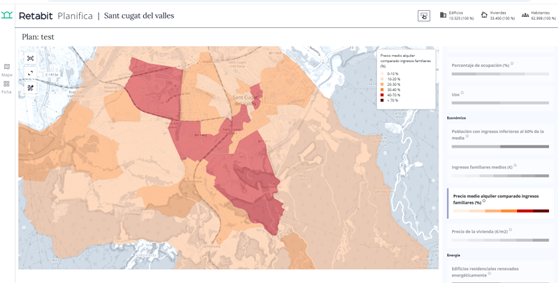
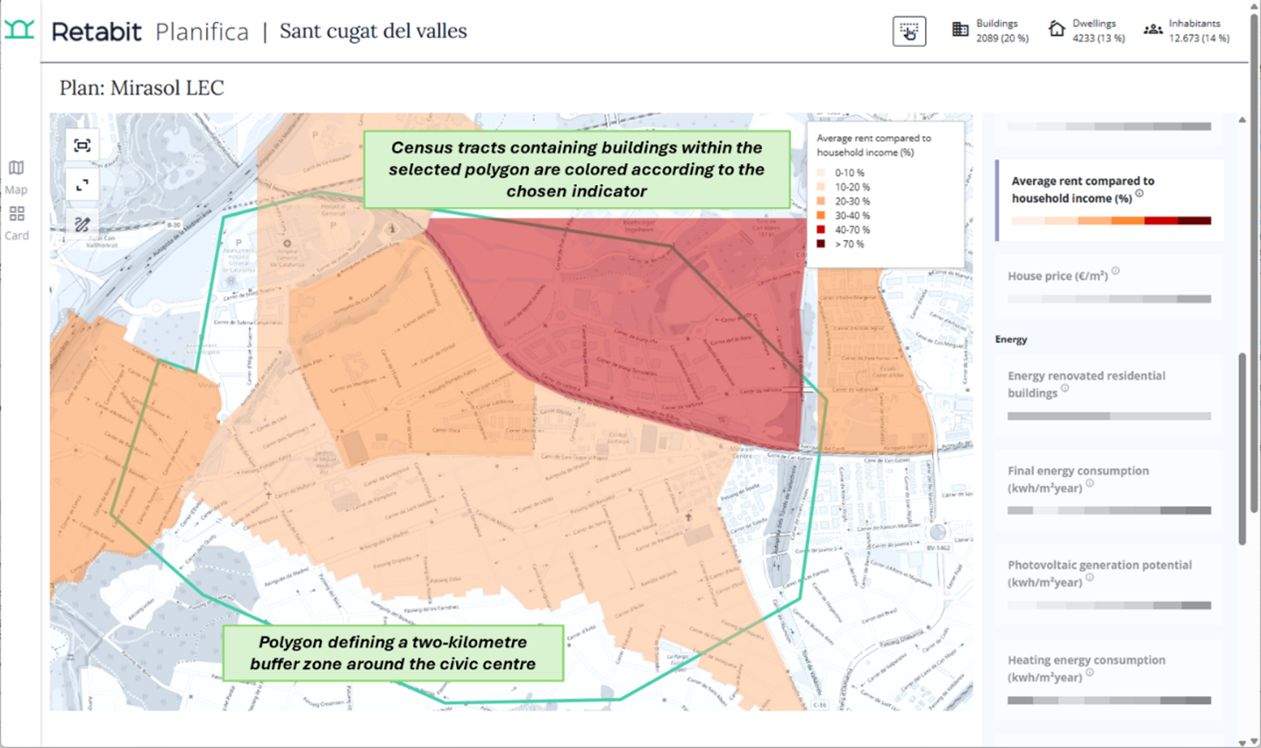
Using RETABIT Analyse, the first step was to map buildings within a two-kilometre radius of the Mirasol civic centre that already had photovoltaic (PV) systems capable of supplying surplus energy. Next, the focus shifted to identifying buildings that could benefit from this local energy—particularly vulnerable households and buildings with limited rooftop solar potential. Municipal technicians used RETABIT’s polygon tool to define the study area, analysing 2,921 buildings.
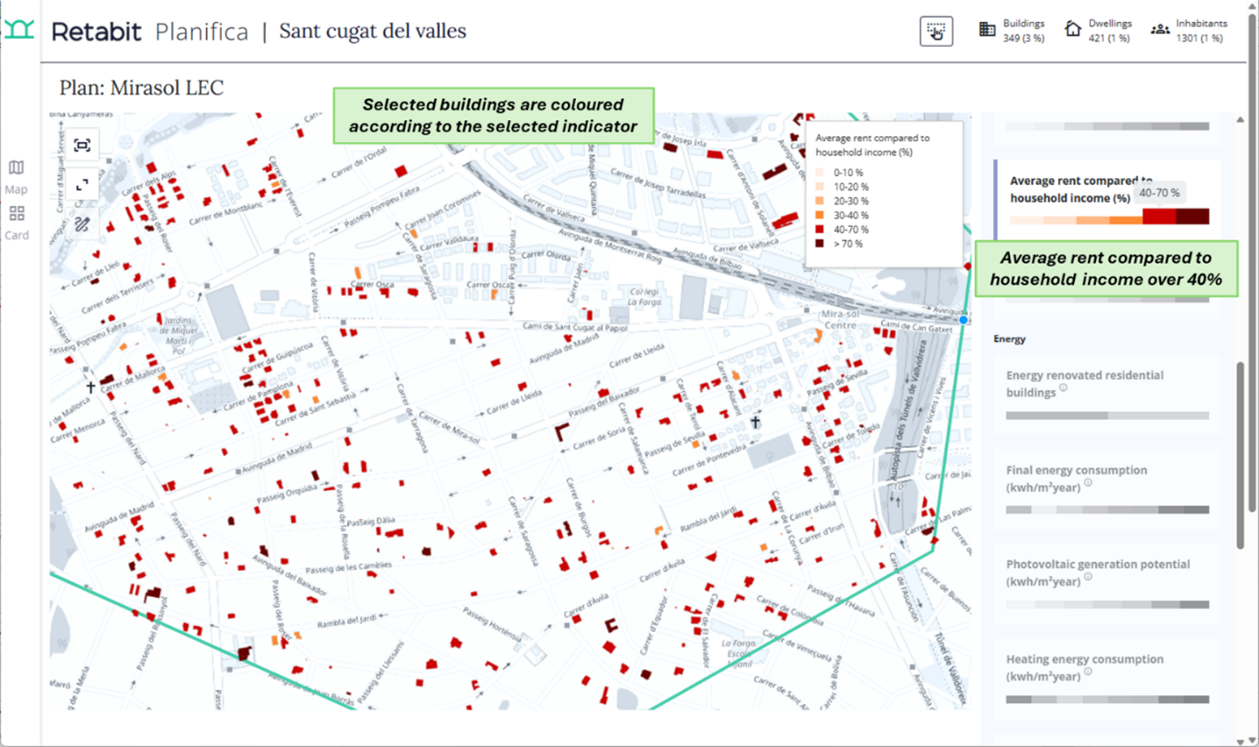
For the Average Rent vs. Household Income indicator, several affordability thresholds were tested. A 40%% threshold was selected based on platform testing and research showing that households spending over 30%% of their income on housing face reduced life satisfaction, with serious impacts above 50%%. The 40%% cutoff strikes a balance between inclusivity and targeting households under significant financial pressure.
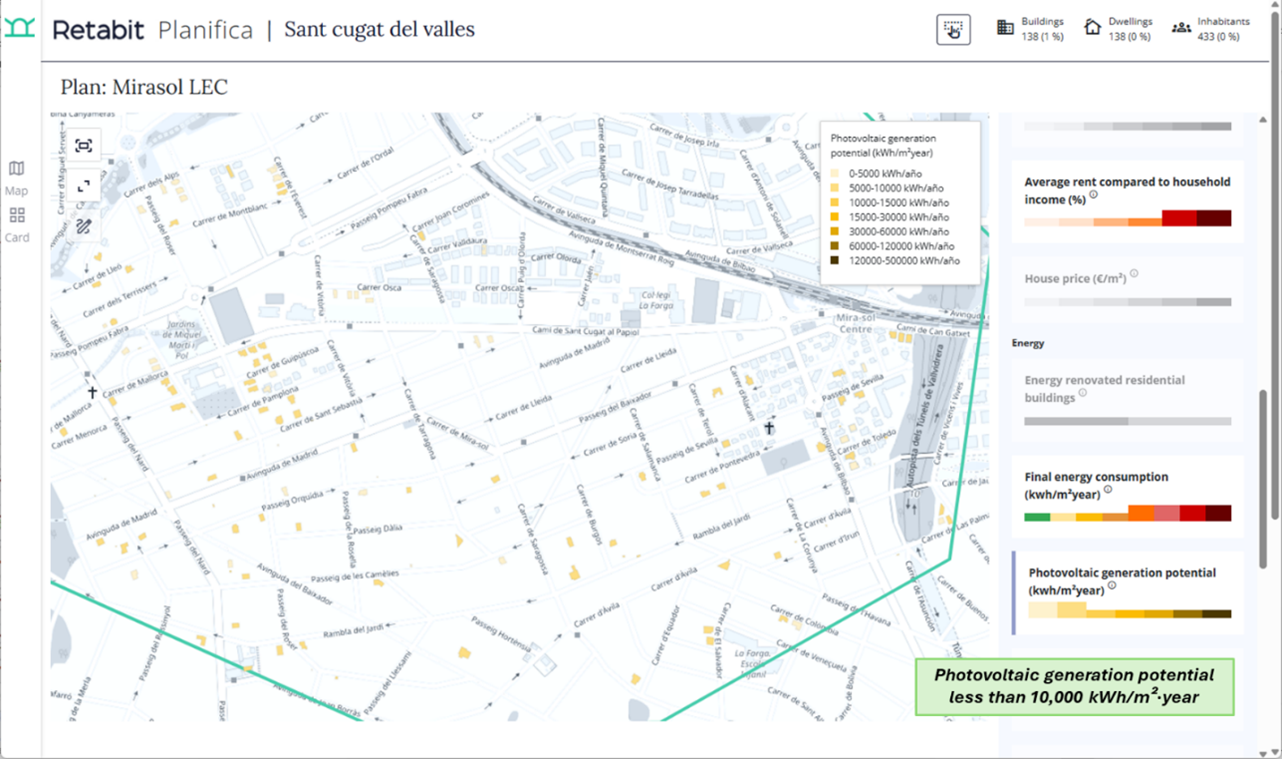
For the Final Energy Consumption indicator, technicians focused on the highest-consuming buildings by selecting those with energy use of ≥ 200 kWh/m²·year, targeting the upper half of the energy demand range. This approach prioritises buildings with the greatest potential for energy savings and maximises the impact of locally generated renewable electricity and efficiency upgrades.
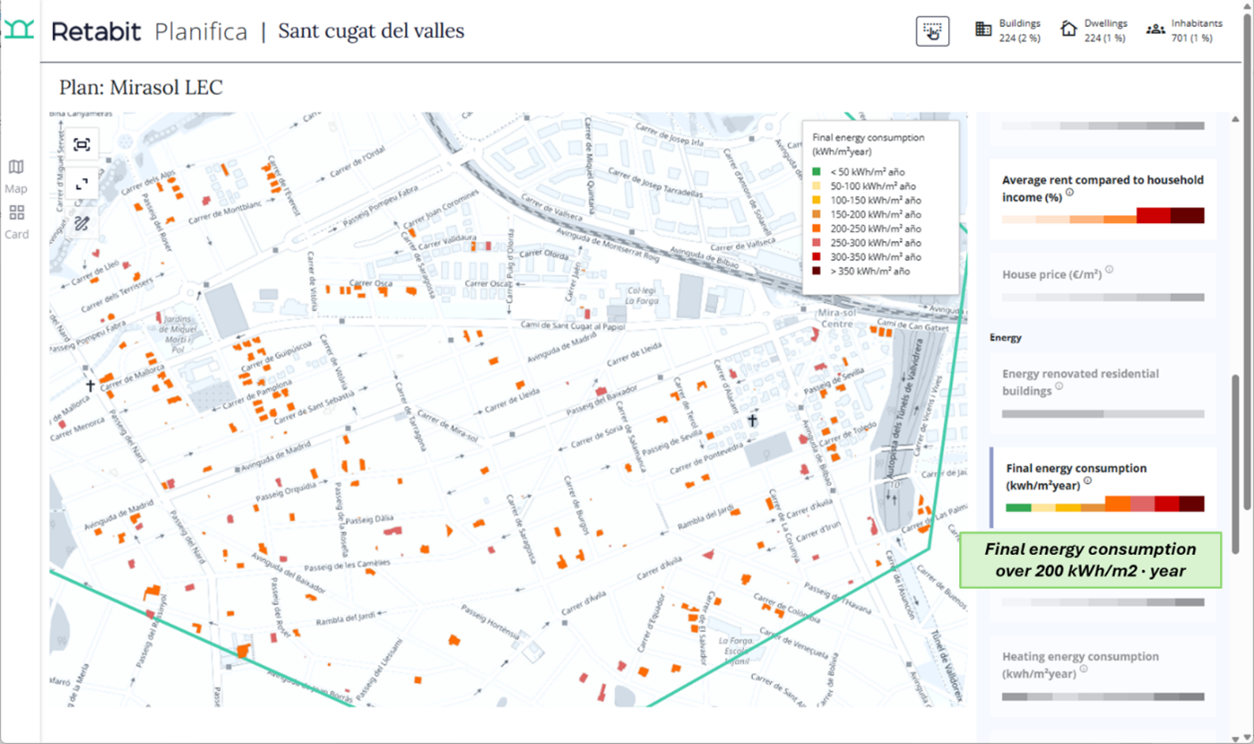
For the Photovoltaic Generation Potential indicator, technicians selected buildings in the lowest capacity band (< 10,000 kWh/m²·year), as these buildings cannot fully cover their own energy needs, even with solar panels. This makes them ideal candidates to act as consumers within the Local Energy Community, benefiting from surplus energy generated by nearby higher-yield rooftops.
As a result of the analysis, technicians narrowed the initial 2,921 buildings to a final selection of 218 residential buildings designated as primary consumers within the Local Energy Community (LEC), ensuring that the benefits of locally generated renewable energy reach those most in need. This case shows how RETABIT enables systemic renovation planning by integrating technical data, socio-economic indicators, and spatial analysis within a single platform. It helps identify strategic renovation hotspots with the greatest social and environmental impact.
To assess the implications of renovating the buildings, municipal technicians designed three distinct renovation projects for the 218 consumer buildings using Retabit Plan:
- Project 1: “Complete renovation”
A one-shot renovation that tackles both the building shell and its mechanical systems. - Project 2: “Façade, windows and roof renovation”
A fabric-first package that upgrades insulation on façades and roof and installs high-efficiency and airtight windows. - Project 3: “Energy-generation equipment upgrade”
Replacing legacy fossil-fuel boilers with high-efficiency mechanical systems.
Project 1: Complete renovation
In this project, a full package of envelope and system upgrades is implemented simultaneously. The measures include:
- High-performance window replacement: Existing units are replaced with pine-frame timber windows (U < 2 W/m²K, Class 4 airtightness), fitted with low-emissivity, solar-control double glazing (g = 0.40).
- Exterior insulation: Installation of a full Exterior Thermal Insulation Composite System (ETICS) on street and courtyard façades, adding 60 mm of rock wool insulation (λ = 0.035 W/mK) after partial cladding removal.
- Alternative window option: PVC-frame windows meeting the same thermal and airtightness standards are offered to accommodate owner preferences and budget considerations.
- Heating system upgrade: Replacement of all individual fossil fuel boilers with a mixed air-to-water heat pump that provides space heating, cooling, and domestic hot water through an integrated storage tank.
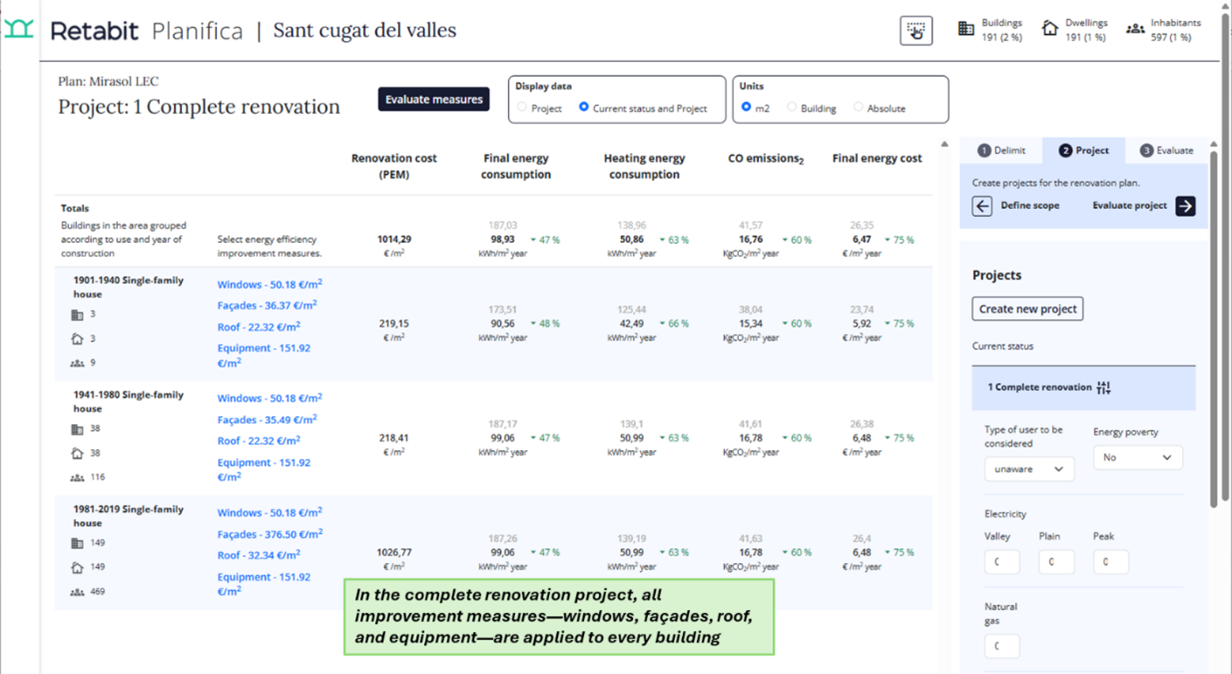
Applied together, these measures provide a comprehensive fabric upgrade, improved airtightness, and full electrification of heating and cooling systems, enabling each dwelling to maximise self-consumption of locally generated solar energy and achieve significant, long-lasting carbon reductions.
Project 2: Façade, windows and roof renovation
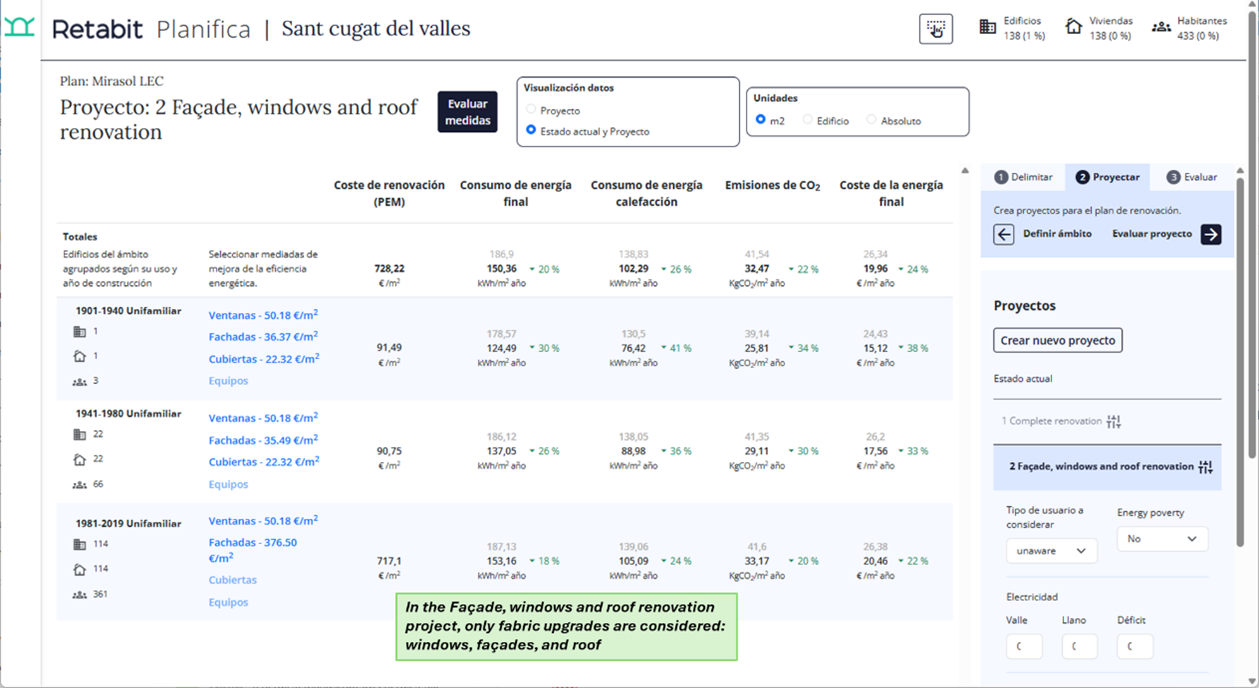
In this project, technicians focus on fabric upgrades—high-performance timber or PVC windows and 60 mm façade insulation. While heating systems remain unchanged, these measures reduce and flatten energy demand, creating a strong base for future solar and battery integration. This option offers homeowners immediate comfort improvements, significant energy bill savings, and access to subsidies, all without the upfront cost of new heating equipment.
Project 3: Energy-generation equipment upgrade
This project considers replacing fossil boilers with mixed air-to-water heat pumps for heating, cooling, and hot water. Done after the shell improvements, this €150/m² upgrade electrifies remaining thermal loads and adds smart controls to optimise use during high solar output or low grid tariffs. While its direct energy savings are smaller than the fabric upgrades, it significantly cuts onsite emissions, boosts bill savings through demand flexibility, and aligns household consumption with the Local Energy Community’s solar generation. Together, the two stages let residents phase costs while progressing toward fully renovated, grid-smart homes that maximise local renewable energy use.
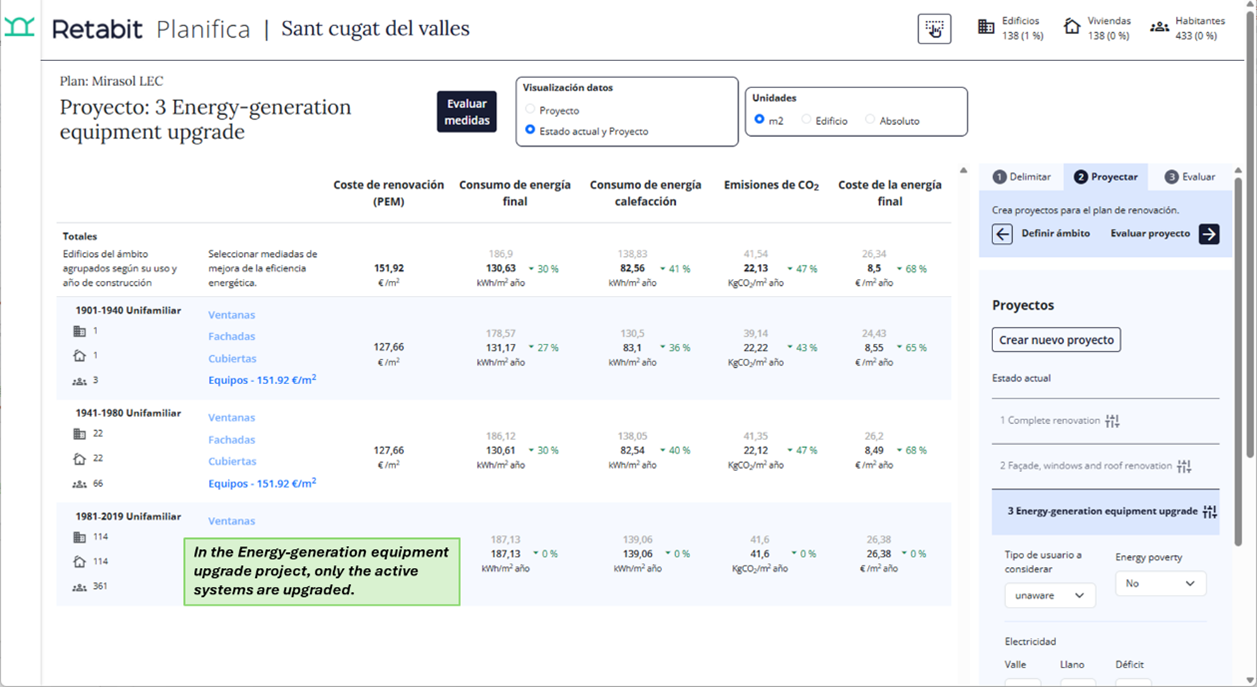
Comparison of three projects
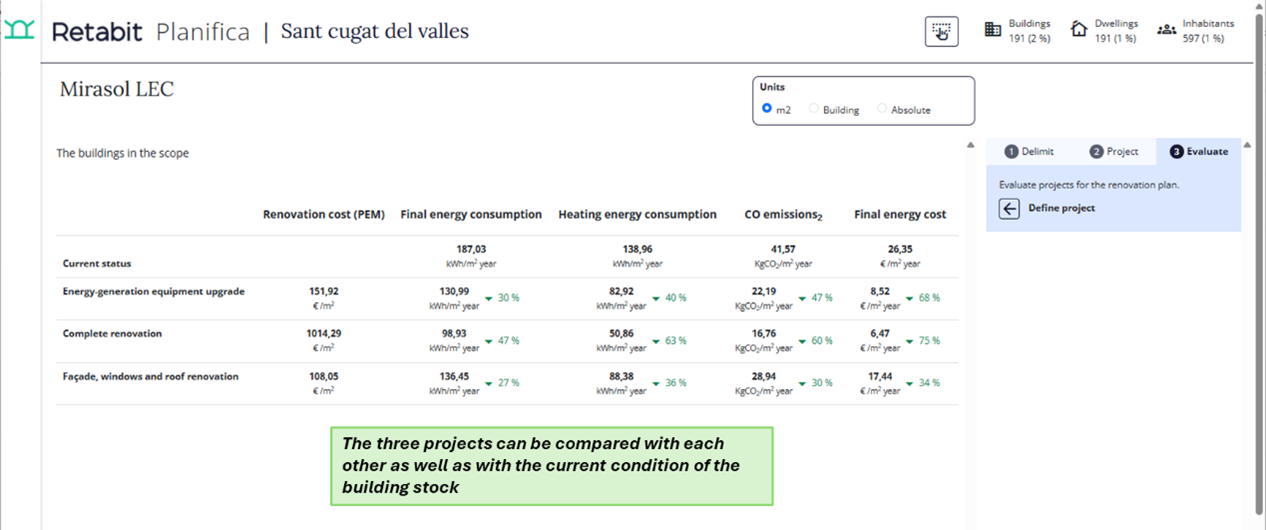
The evaluation shows all three renovation options significantly improve energy performance, but with varying impacts. The “Façade, windows and roof renovation” reduces energy demand by ~27%, heating by ~36%, and cuts bills by a third at €108/m². The energy equipment upgrade, costing €151/m², lowers demand by ~30%, emissions by 47%, and bills by 68% through heat pump electrification and smart controls. The full deep renovation, combining both, delivers the greatest savings: 47% energy, 63% heating, 60% emissions, and 75% lower bills—all at a similar total cost. This allows for flexible investment: phased upgrades or a one-step retrofit, both offering strong efficiency, carbon, and cost benefits while maximising local renewable energy use.